Percy Moo as Einstein

Percy Moo as Einstein
Dog=Einstein2

Thursday, 19 September 2013

Eureka! Or: What Archimedes and Physics Teachers Never Told Us about Displacement

Image courtesy of mizantrop.co.il
We have all heard about Archimedes and his famous bathtime activities of splashing around, his wooden duck falling onto the bathroom floor with the overflow. This discovery helped us all understand why things float and why rubber ducks are better than wooden ones (fewer painful splinters and fewer cracked tiles). What we have never been told is why he was in the bath in the first place. For hygienic reasons, perhaps, but I reckon old Archie was there as a literal and figurative displacement activity.

Probably he should have been out shopping in the agora for that day’s dinner in Teskonotos or Asdakopoulos. But hey, it was a hot day, the streets were full of hoi polloi and Konon the barbarian slave was occupied clipping wifey’s toenails. Perhaps, even, he should have been drawing up plans for some new invention to help the contemporary Athenian’s life be that little bit more connected, more interactive, with easy-to-use eikons. Anyhow, to postpone the dreaded moment he decided to have a bath and pluck the hairs off his toes. He definitely was not worrying about the state of the Athenian Oeconomy and the overbearing demands of his Teutonic masters to reign in government spending. After all, the nothern barbarians were still running around naked and fighting Russel Crowe and his dog Wufus on the Danube.

Whatever. First he decided to have a nice, hot bath. No energy-efficient, environmentally-friendly showers for this lad. And in so doing he discovered displacement and - more importantly - the displacement activity.

I am a Master of Displacement. Sometimes, when not involved in displacement activities, I have the dubious honour of working for one of the, gulp, world’s top 500 universities. In fact, this post is a displacement activity in itself – and so far I have left it three times. I have convinced myself that it is imperative that I (wet) shave
I actually remember this type of washing
machine! Image courtesy of permaculture.co.uk
and on the way back from the bathroom look at the bed to remind myself that, eventually, I will have to make it. Finally I had the unavoidable urge to check that the washing machine is still going round. I love watching our washing machine (good pronunciation practice that bit, I’ll have to use it in a class!) but I love the old ones better. They used more water and you could see lots of little bubbles and the clothes sloshing about, displacing the grey water.

Where was I? Oh yes, displacement. This year my commute is slightly longer than before and involves a one-hour drive to work. I therefore need to commence the leaving process at least two to three hours before starting work. Why? First I have to have a shower, get dressed, have a mighty powerful hot drinking coffee and get to the car. This obviously involves all of the above, but also might include re-arranging the stuff in the bathroom cabinet while looking for the deodorant I bought last week but will not need until the other, full, can has been exhausted.  Then I might also look for the sachet of sugar that a colleague gave me to put that into my coffee instead of using the jar of sugar in the kitchen. There then ensues a lengthy round of checking up on emails, Facebook, etc. Finally I get into the car and drive off.

My Ford is the best car in the world. It isn’t new, but has enough technology to keep me happily occupied while driving. I set the fuel consumption display to show how many miles are left before I need to fill up. This means driving at various speeds to see how this figure rises and falls, the occasional overtaking and scanning of the skies for traffic helicopters &c. &c. &c. Therefore, the one-hour drive might take 45 minutes in Rammstein listening mode or it might take 1 hour 20 minutes if I’m in end-of-the-month fuel-saving mode. It all depends.

Once at work, I have time to check my emails (usually publicity or official university emails that I delete unopened), chat to the admin. staff, flirt, have a coffee, peruse our own lending library, enjoy some banter with colleagues, read a blog or two, start listening to Radio 4 and then realise class is about to start.

The classes themselves are a goldmine of displacement activities: I observe the idiosyncrasies of the students and mentally note them for use at a later date; I play with the computer (obviously after freezing the image on the projector) and, of course, reach the day’s teaching objectives while trying to keep the students interested and amused. Although I say so myself, I usually manage all three quite successfully.

I sometimes wonder if, in fact, work is my real displacement activity. Classes over for the day, the whole process begins in reverse. I –

Sorry, must go. There’s a crooked picture on the wall facing me and I absolutley must straighten it before going for a wander around the local supermarket to see how much Bombay Sapphire gin costs this week – it’s a great indicator of the pound-euro exchange rate. You could try something similar at yours, using a bottle of Sherry or Rioja.


PS. Bombay Sapphire is currently €21.95 in Mercadona. The pound is on the up.

Thursday, 5 September 2013

What Did The Romans Ever Do for Us? Manly Grooming Advice

An early ZZ Top fan.
Photo courtesy of 
fastfancydress.co.uk
Well, apart from aqueducts, sanitation, roads, &c., as acknowledged in Monty Python’s The Life of Brian, the Romans gave Europe the craze for depilation. Indeed, Roman bathhouses were full of the yelps of Romans (and Rowomans, let’s not be sexist, here!) having excess body hair removed as hirsuteness was considered as being barbaric. Indeed the words barbaric and barbarian come from the Roman word barba, or beard.

Eheu!!! Quod nocet!!!
Depilation was performed all over the body using tweezers and slave labour – even such sensitive bits as the armpits were denuded using this eye-watering method.

And it is about beards that I want to talk yet again. Readers of my blog might remember this post. In the last few months, I have had a change of mind and am now once again clean-shaven. This obviously entails shaving and the corresponding purchases of essential shaving tackle – face scrubs, aftershave, razors, skin toners, moisturisers, shaving foam, &c.

Well, actually, let’s pass on the shaving foam. I shave like a Roman. Do I use tweezer-wielding slaves? No. I use oil and not the expensive shaving oils that you find on the High Street. I use either olive oil straight from the bottle – obviously if it has been in the chip pan it has lost a lot of its properties and gained some crusty bits . This may seem an extravagance, but compare the price of a litre of Extra Virgin olive oil to the price of a small bottle of shaving oil. Alternatively, I use baby oil. Both have many other exotic uses, but try shaving with them. It’s cheap, natural, moisturising and gives excellent results. Ea.


Wednesday, 4 September 2013

How to Speak Non-lexical Spanish and Impress People

Constant is the debate between Spanish and English speakers over which language has more words, which is the richer, &c. &c. &c.

English, obviously!

However, there is one area where Spanish has English firmly beaten: non-lexical interjections. This is probably due to the Latin roots of Spanish. As anyone who has studied Latin knows, it is bursting with such interjections. Arturo Pérez-Reverte, one of Spain’s most popular authors – his books are actually readable instead of the usual logorrhoea pumped out by writers in Spanish both past and present – has on occasion referred to English as the onomatopoeic chirrups of a race of shepherds. In so saying he is referring to the brevity of English words and syntax. In other words we can usually say a lot in English in a small space. However, when it comes to non-lexical portmanteau interjections, Spanish trumps us hands down.  

My favourites are "ea", “ojú” and “halá. The first two are common in Andalusia, while halá is common coin throughout Spain. To become a master of the ea, you pronounce the e as the English letter A, and then follow it with an a, as it at) You should also try to add a slightly nasal twang for optimum effect. “Ojú” is quite easy to pronounce: o as in odd and a nasal jú as in who?, coupled with the rising intonation of a question. There are other variations for those who crave variety: “Ofú”, as in tofu – without the t; rising intonation;  and “Osú”, also with a rising intonation. It also helps if you let your cheeks go loose to give any of the above versions a certain slurred plosive quality. True experts and other advanced practitioners might even venture to add the merest hint of a smidgeon of a cough for a truly dramatic effect. The pronunciation of "halá" is as follows: silent h, a as in at and la as in lad, the stress falling on this second syllable. Usually the second a is quite a prolonged affair, maybe lasting a couple of seconds, or even more.

First, ea. This is a multi-use expression usually employed to denote finality. If you want to add emphasis to a statement, or turn an opinion into a universal fact, add ea.  

 “My dad's bigger than your dad. Ea.”

Mine's got more 
emeralds. Ea.
Mine's got a nicer suntan. Ea.
“My church’s statue of the Virgin Mary is prettier and more miraculous than yours. Ea.”

This issue is actually quite a serious matter here in Seville where people seem to have forgotten that even though the idols might be different, the deity being adored is the same. Still, logic and religion have always been strange bedfellows. Ea.


It can act as "I told you so.":
"Ea. What did I tell you? Now you've gone and burnt the gazpacho."

A: "Ofú! My MP3's on the blink.
B: " Ea. Didn't I tell you that buying a cheap Chinese one was a false economy?"

You can also use it as a form of bidding people farewell as you get up from a meeting/leave the pub to go home:
“Ea, gents, I’m off to tell the wife I've just got the sack. Ojú”


Let us now take a look at “Ojú” and its variants. Ojú is used to introduce a statement, usually with an element of fear, exasperation and resignation.


When the boss finds out you’ve been stealing pencils and paper clips.
“Ojú, I’m in for it now...”

On a hot day (40ºC+):
“Ojú, I’m sweating like a pig.”

When your child comes home from school with his/her exam results:
“Ojú, ojú, ojú, ojú, ojú.”

For greater emphasis, add vamos (va as in van, mos, as in moss. The more experienced can remove the s and say: “vamo” while the true expert can experiment with the even shorter “amo”.

Indeed, Vamos and Ojú can be concatenated indefinitely:

Adolescent daughter: “Daddy, I’m going to have a baby. Rodrigo and I love each other and he says he wants to marry me”

Sofa-bound son with a mouth full of crisps: “Haláaaaaaaaaaaaa!!!”

Terrified father: Ojú, ojú ojú, vamos, ojúuuuu, amo, amo, amo, ojú, ojúuuuu, vamos. Osú osú osú. Vamo, vamo, vamo.

Practical mother: “Ea, I told you he was only after one thing, vamos.”

Finally, halá denotes surprise, annoyance and outrage at any form of undesired excess, or disbelief at an obviously egregious lie. For even more emphasis, you can add a sort of strangled gargle at the end:

On being overtaken on Sluice Road by a boy racer rattling past at 60mph: 
"Halaaaaaaaaaaaaaaagghhh! Where's the fire, brat?"

William Hague to the British press 08/08/2000: “I drank 14 pints of beer a day when I was a teenager.”
Plain People of Britain: Haláaaaaaaaaaaaaaaaaaaaaaaa!

A: “How much did you pay for that fake iPod?”
B: “€50”
A: “Haláaaaaaaaaaaa. You can get one for €10 in the Chinese shop.”
B: "Yeah, but will it still be working next week? Ea.


Tutti Frutti
On being woken up at 3am when the glass recycling container just under your bedroom window is being emptied: 
“Haláaaaaaaa! How’s a body to sleep with all that din?”

When your neighbours' annoying child vomits on your rug after scoffing the tub of your favourite ice cream (selflessly given to him by your good lady wife) you were keeping to enjoy while watching Real Madrid vs. Barcelona that evening:
“Haláaaaaaaaaaaaaa! Who’s going to clean that up? I’m not.


Fast and Spurious
Boy Racer talking about his superannuated Opel Corsa in the Saracen's Head, Holbeach St. Marks: “I did 115mph down  Sluice Road on the way here.”
Unimpressed mates: “Haláaaaaaaaaaaaaaaaaa!”

Drunken Husband: “Sorry I’m late, darling. The boss just sacked me for stealing pencils and paper clips.”
Exasperated wife: “Haláaaaaaaaaa, Who’s going to pay for my bingo cards and the baby clothes now, eh?


Or, if you are into brevity, quite simply say:
“Haláaaaaaaaaaaaaaaaaaaaaaaaggggghhhhh!”


Ea. That’s all for now.

Saturday, 24 August 2013

The Grown-ups Are Fighting in the Sandbox, or Little Fishies (Caught Between a Rock and a Hard Place)


Gibraltar as seen from mainland Spain.
Recently a friend of mine who lives in England emailed me to ask how things were over here in Spain vis à vis the Gibraltar brouhaha. Well, folks, here on the average Spanish street, there is no Gibraltar issue. Spaniards tend to pasarlo por el forro de los cojones, in other words, they couldn’t give a poo. What is interesting, however, is how the whole issue throws light on various national tendencies and characteristics.

First, though, a little bit of history. Gibraltar became a British colony in 1713, when the UK traded Menorca for it under the Treaty of Utrecht. Today this might seem like a rather bad deal but we must not forget that Gibraltar is at the mouth of the Mediterranean and as such was of huge strategic significance when Britain had an Empire and wars to fight. Now, however, with the advent of nuclear submarines, aircraft carriers, long-range bombers, cruise missiles &c. and the US 7th Fleet just up the coast in Rota, Gibraltar is, in strategic terms, quite unnecessary. And here the problem begins.

Gibraltar is a British Overseas Territory and is self-governing in everything, but has to respond to GB in matters of policing, defence, foreign policy and governance. Such status also means that as long as the people of Gibraltar want to remain British, Great Britain cannot get rid of this troublesome “rock”.
Plenty of room for ciggies in the 
back.

And troublesome it most certainly is. In my humble opinion it is more a reason for shame than for national pride. It is home to money-launderers, smugglers, tax-dodgers and online gambling companies. If anyone could explain to me where the huge number of teenage chavs driving around the streets of Gibraltar (yes, there is more than one street – just!) got the money for their fully boom-boxed up BMW M3s and tuned-to-the gills American trucks, I would be grateful. I can’t explain it - legitimately. Gibraltar is the distilled essence of all that is bad in British society.

In the past, Gibraltar had its uses for us Brits in Andalusia: it was a place to go and stock up on tea, Cheddar cheese, Digestive biscuits, creme eggs, cheap duvets and whatnot. Now, however, such delicacies (except creme eggs) are to be had in Mercadona, an omnipresent Spanish supermarket. Duvets etc. are on sale in IKEA at even lower prices in Seville and Jerez than in Gib., especially if we take into consideration the murderous euro/pound exchange rate unscrupulously exacted on the unwary traveller by money-grabbing Gibraltarian shop owners[1].  Even the Gibraltarians go food and furniture shopping in Spain – mainly to Jerez.

Spanish Fishermen with their 
illegal nets? Spanish ciggy 
smugglers? Depends on the day, 
José

.

But to the present “problem”. This is nothing more than posturing on all sides for political gain and summer headlines. In my opinion the Gibraltarian government comes off morally the worst. The present kerfuffle was provoked by the dropping of 70 concrete blocks in disputed waters. The ever-rapacious Spanish fishermen whine that it will destroy their livelihood, instead of letting them continue to do it quite efficiently for themselves with their illegal nets etc. They should be happy. They might be able to squeeze yet another subsidy out of the central government, paid for out of the taxes of those of us still in economically productive work. If not, they can always go back to their day job of smuggling hashish and ciggies from, yes you’ve guessed it, jolly old Gib. The Gibraltarian eco-warrior government is so obviously acting in defence of the little fishies that this probably has nothing to do with its own internal popularity ratings or general Spain-baiting bloody-mindedness[2].   

A bristling gunboat. Hooray!
Gibraltar's government is like a spoilt little brat throwing (in this case almost literally) stones at the bigger boys and then running to hide behind his older brother when the nasty bigger boys come chasing after him. Poor older brother! Through no fault of his own, he finds himself embroiled in playground squabbles that really shouldn’t concern him – or is he such an unwilling participant? It would seem not. The British government has sent gunboats “bristling over the horizon” to quote Boris. And we all know there is nothing quite so popular in Britain as sending a gunboat - preferably with the band of the Royal Marines playing on deck as it leaves port - somewhere to frighten Johnny Foreigner and, if necessary, give him what for.  It’s a good job we’ve still got some gunboats left – for the moment. It might, however, be rather difficult to give the greasy Dagoes what for, considering that they are our NATO allies.


Keeping the Empire - and Spain - out 
of the hands of Johnny Foreigner at 
the British taxpayer's expense.

Let us now look at the Spanish government, struggling in the mesh of a series of corruption scandals. What better way to bury an inconvenient story than to unite the people behind a truly grand national issue such as the sovereignty of a pirates’ nest just off the coast of one of Spain’s most economically depressed provinces? This is one of the oldest tricks in the politicians’ books: to unite a nation, find a common enemy. It worked really well for Bismarck and Hitler. However, were Spain to succeed in regaining Gibraltar, It would find itself with a huge new drain on its defence budget. Yes, British taxpayer, you are paying millions to defend southern Spain from Maghreb aggression. Mainland Britain sure as hell is not on the Maghreb radical Islamists’ shopping list of territory in the hands of Infidels. Al-Andalus most definitley is. The newly-taxed ciggies might go some way to meeting the cost, but not very far. 

  Orf for a jolly time in Sotogrande 
  to spend some of our tax-free 
  snotchers.
Economically, Spain is at present cutting off its Rock to spite its face. All of those Gibraltarians who have holiday homes on the Costa del Sol or in the Sotogrande millionaire’s country club, as well as those who shop in Spanish hypermarkets and malls are now being discouraged from doing so by the hours-long waits at the frontier. I have seen this with my own eyes at the almost deserted Jerez shopping mall. Thus the Spanish government is further depressing the depressed province of Cádiz. Obviously, they will still be letting the ambulances through so that the poor, persecuted Gibraltarians can continue to enjoy the high standard of service offered by the Andalusian Health Service – better than any I have ever seen in the NHS. And obviously without contributing to the costs. Guess who does that, O British taxpayer?

All in all, then, this latest episode of tri-partite jingoism is serving the politicians on all sides quite nicely while costing the British and Spanish taxpayers money that they can ill afford on the mock defence/siege of a limestone outcrop that would be better off as Spanish province. It’s a pity we didn’t hang on to Menorca; at least we might have first dibs on the sunloungers before the Germans.
Probably a lot more polite than some of
Gibraltar's "finest" - see footnote 2.


[1] A note for the British tourists: British pounds are legal tender in Gib, but the same is not true of Gibraltarian pounds in GB.
[2] A personal anecdote: Once when entering Gibraltar in my Spanish registered car, a PC snapped his fingers and whistled at me as if calling a dog over. When I got out and remonstrated with him over such discourteous behaviour, his excuse was “I thought you were Spanish”. Disgusting.

Saturday, 8 June 2013

The Horror! The Horror!

I apologise beforehand that this is a slightly ranty post moaning about the youth of today, though I hasten to add I am talking about a select minority.

In my HE establishment, the exam season is in full swing. This is the time when the academic sheep are separated from the goats. It is a time of emails asking for information that has been published on our website for weeks, information such as: Hi teacher, I'm Jose/María, "Where/When do I take my exam?" "Can you tell me what is in the exam?" &c. &c. &c. And, most egregious of all: "I'm not sure if you're my teacher, because I haven't been to class, but could you please email me all of the extra materials that you've handed out during the course?".

Often such enquiries don't include the student's level or group number. I know that teachers are supposed to be omniscient creatures, but to know who Jose (Er.PepeLu.Sevillista@tontodelculo.com - an invented address, I hope!) might be  is beyond even our Holmesian powers.

And then there are the exams themselves where students point out that the exam contains mistakes; that it is impossible to place only one word in such and such a gap; they ask which is the correct answer in number 16 and a long list of other doubts.

Some turn up to university exams with their mums! Others arrive without writing materials. Having commented my disquiet at being a teacher in a kindergarten for young adults to several secondary school teachers, they have looked at me pityingly and asked me if I think that they don't have the same problems  

As mentioned above, quite a few students seem unable to find information on our website - or even the website itself. How is such a thing possible in a society where everone, both young and old, have a smartphone, Facebook and Twitter accounts and are able to illegally download music, films, TV programmes, &c.? The answer I fear is twofold. Firstly they are too lazy/uninterested to find this information by themselves and, more worryingly, our society in increasingly infantile.

We, and our children, are being reduced to a state of total dependence on others by the dazzling array of apps available. Our capacity to think for ourselves and take the initiative is being undermined by the fact that it is easier to offload such tasks to small pocket-held devices. It is obviously more convenient to use a calculator instead of dividing 4,356,798 by 17. Indeed, that's how I do it. But, like the consipated mathematician, I also know how to work it out with a pencil and a piece of paper. Unfortunately, young people don't.

Not too long ago I had a rather bizarre conversation with a 25-year-old student who told me about her recent visit to Disneyland. She enjoyed it hugely. I asked her, in ironc tones, if she had got Mickey Mouse's autograph. To my surprise she went misty-eyed and told me that she had - and Minnie's and Donald's too! She really did believe that three French students, dressed in foam rubber, were the real characters.

Yet another example. Next time you're in a public place, observe the people - of all ages - drinking water or sports drinks from bottles. Count how many have screwtop bottles and how many have the sort with a pull top that let you suck from the bottle on the go. All very convenient, but take pause; they are literally sucking at the teat! How infantile is that? I despair.

O tempore! O mores.


Tuesday, 14 May 2013

Flags and Words

On my last trip to Cádiz, I took some time to watch a 3-metre Spanish flag undulating and unfurling in the breeze. Here is a rather poor quality video of it. 

As I watched I was moved to remark to my Dark Lady on the beauty  
of its movements and commented that what it was really doing was giving form to the air that moved it.

On later reflection, I concluded that the same could also be said of words. They are a way of expressing the essence of the torrent of ideas and emotions that we all try to communicate to our listeners. We all know that, however rich our mother tongue  - and, indeed, our own personal vocabulary - saying all that we want to say can at times be extremely difficult, if not impossible. Words, like flags, can only give the merest hint of our underlying thoughts and emotions.

Since the dawn of time flags and standards have been used as a rallying point for warriors in battle. Now, luckily, a flag can mean many things. In Britain, as in Spain, flags today are a symbol of regional or national pride of and our confidence in the future.  Thankfully, in recent decades our national flags have been stripped of the more sinsiter messages with which ultra-nationalists in both countries endowed such emblems. Today this abuse no longer exists and a flag flying in the breeze can be appreciated for what it really is, a thing of beauty whose only message is that of giving form to the wind - as our words can also be used to express, however poorly, our finest emotions. Our less noble sentiments need fewer words - usually monosyllabic plosive ones.  These latter are not flags, but mere litter being blown about in the gutter.

Thanks to MB for such an impressive photo
08/06/13
Since the original post, MB, a dear friend and seasoned aeronaut, has sent me some of his favourite flag photos. As an aeronaut, the study of wind and the air is of great interest to him. Here's one he took in Cuba. In the distance you can see the old fortifications of La Habana - the fortifications that were the model for those of Cádiz, as mentioned in an earlier post: We Know Where you Woz


Speeding across the Bosphorous, where Europe meets Asia.
Finally, and for me the most exciting, one from MB's visit to Istanbul:


Footnote:
Later on the same day while visiting the city's Parque Genovés, which gives onto the Bay of Cádiz, I discovered a monument dedicated to All of the Fallen in the Battle of Trafalgar, inscribed with the names of the Spanish, British and French ships that fought so heroically and bloodily on October 21st 1805. A fine, generous sentiment from the city of Cádiz which lost so many of her sons, pressganged into sevice, that fateful day.


Sunday, 28 April 2013

A Conversation Overheard

We can just make out the name 
The news in Cádiz this weekend was the arrival of Cunard's latest Queen Elizabeth. It was a sight for sore eyes to see the Red Ensign fluttering from a ship of such importance. The problem is that it looks no different from all of the other cruise liners that moor here - except perhaps that it's even uglier. This slab-sided floating prison where people pay through the nose to be relentlessly entertained has none of the romance or beautiful lines of Cunard's former queens of the sea. Some useless information: when the QE2 came to Cádiz, it had to drop anchor in the bay and its passengers were ferried ashore in lighters because of its draught. I was told this by Jesús el Cura, one of my tri-dentine wine-drinking pals.

In fact, and it hurts me to say this, the French cruise ship that was also moored there put the QE to shame. And Yes, as well as having hefty engines, it really was a sailing ship. It was truly, breathtakingly, beautiful, not like Cunard's luxury outsize shoebox. I know which I'd rather be on if I had to go on a holiday for battery hens. What is the attraction of being shuttled around from city to city on an outsized shopping mall anyway? It beats me.


L´élégance, ma p'tite choux
 Anyhow, to the conversation. In one of the local bars we overheard a crew member from the QE talking to his counterpart on Club Med's ship, La Belle Bite I think it was called. They were comparing working conditions, wages, turn around times, the obligatory - yes obligatory - tips charged to their prisoners, private health insurance &c. &c. &c. It turned out that the QE man worked less, got paid more and had more fringe beneifts. Poor Jean Louis was désolé while Bollocky Bill from the QE came out with the clincher
"Yeah, well I work for Cunard, innit?"
Jean Louis' mournful rejoinder came back
"So do I. And I work longer hours, but I don't get half of what you do!"

If you didn't get it, read it out loud and you might just enjoy it. OK, It's an old joke, but hey, it deserved an airing and the bracing air of Cádiz this morning most certainly blew away the cobwebs.


QE and Ls Belle Bite moored together and not a cannon in sight!
I couldn't get any closer as the Port is closed to the public. A couple of hours after this pic was taken, hailstones the size of peas were thundering from the skies. Nice Ford Focus in the foreground.

Sunday, 21 April 2013

A Snortlingly Good Recipe

- Even for carnivores like myself!

Spinach with Chickpeas.


As with all of the best recipes, it's a to-taste one.

Ingredients:

Spinach, fresh or frozen - frozen is best as you can calculate better how much you're going to get after boiling it.
Salt.
Several peeled cloves of garlic.
Dry bread.
Whole cumin seeds.
Sweet paprika powder (preferably Spanish).
Olive oil (preferably Spanish).
Pre-cooked chickpeas - if you have some (a lot) left over from a chickpea stew, even better!
Vinegar (preferably white wine or cider).

Method:

Boil the spinach in salty water and drain. I usually keep some of the water back to use as a base for soups.
In a small frying pan and using quite a bit (slightly more than you would normally use) of olive oil, fry the bread until it is golden brown. Remove the bread from the oil and then fry the cloves of garlic idem. Fry at a low temperature. It does not matter if the bread soaks up a lot of the oil, but please do not fry in smoking oil as this burns the oil and we are going to need it later.

While frying the bread and garlic, put the drained spinach into a frying pan, sprinkle liberally with the paprika and gently heat to remove the excess water, stirring often.

Image courtesy of recetas-algarra.blogspot.com
Pound the bread, garlic and cumin seeds in a mortar and pestle, either separately or together, depending on the size of the mortar.

Pour the still-hot oil onto the spinach and add the  pounded bread, garlic and cumin.

Pour in some vinegar, add the chickpeas and cook the whole together over a low heat, moving it continuously until all of the water has evaporated and it has the consistency of the example in the photo.

Serve piping hot and enjoy with a good white or rosé wine and plenty of crusty bread.

If there's any left over, it can, of course, be frozen and later (gently) microwaved at a future date. When microwaving, use a medium setting and stir often

If you are feeling particularly adventurous, you can add beaten egg to the dish before serving. This adds a certain creaminess, but makes it a bit bland - a good way of reducing the punch of the spices if you think you've added too much.

My general tip for herbs and spices is add twice as much as you feel comfortable with - but that, of course,  is a personal opinion.

For the true carnivores: You could always try frying some chopped bits of bacon or diced cured ham until crispy in the olive oil before anything else, and chucking it onto the dish just before serving so that when served, it still retains that wonderful fatty crunch. 

A digression: It wasn't that long ago in England that you could only buy olive oil in small bottles from the chemists to relieve earache or earwax. How times have changed! Where now the oft-criticised "Greasy Dago" of times past? I'd still rather fry my chips in lard, though. Heart attack city, but well worth it! As they say in Spain, "You've got to die of something some time".

Friday, 19 April 2013

More Thoughts on Manufacturing, The Materials Used and Manpower.

In recent posts, I have mused on all of the above and have on several occasions mentioned my iPod.

Before I begin, I want to make it absolutely clear that I am not an iPostle of the late Steve Jobs, although I am an admirer of his (megalomaniac?) vision and his quest for perfection in design and ease of use. Neither am I a slave to designer labels.

Obviously when we buy a prestige product, part of the high price is simply a premium for having this or that logotype on it. This logo, however, is also a seal of quality. When Apple presents a new product, it is staking its whole reputation on it. When Hua Xin Wei (invented name) brings out its latest mp4 player, it is staking very little on it as it has, and probably never will have, a reputation to protect. It will sell this product before moving onto its next which may not even have the same brand name.

Therefore, what does quality matter to such manufacturers? Very little. They will market a product with the same memory capacity as an elegant aluminium-cased iPod at a fraction of the price. It will be made of cheap, fragile plastic with cheap, fragile controls and when it breaks after a few months or the first time you drop it, so what? Chuck it and buy a new one. As the saying goes: "You gets what you pays for". In this case you pay for cheap materials, cheap labour and shoddy workmanship.

I know that my iPod was also assembled in China. Please take note: it was assembled in China. Its most important constituent parts were made in Korea and the US. Its supposedly inflated price is a guarantee of quality and good workmanship. I should imagine that the rejection rate during all steps of quality control is rather high to ensure excellence in the product sold. Another example of such stringent quality control in a premium product is that exercised by Ferrari. Their chassis are made to tolerances of microns and if they do not pass the quality control, they are scrapped - not re-machined, recalibrated or re-assembled. They are scrapped.

Another element to consider is the attitude of the workers themselves. Workers in a factory producing prestige articles will take a greater pride in their work - and will in all probability be paid more. Top-down excellence is a key to good manufacturing. Cheapness per se is not a good thing. Indeed, arch-capitalist Henry Ford well knew this. In 1914 he decided to pay his workers $5/day - double the going rate. This attracted the best and brightest mechanics in Detroit, cut his training costs and reduced the turnover of labour, making the Ford company highly profitable and enabling its workers to buy what they produced - thus creating further demand for its cars.

If your employer treats you with contempt, then you will treat your job with contempt and resentment, slinging the finished product together or offering sloppy service. Remember British Leyland in the 1970s? It was a company riven by politics and class - even prestige cars such as Jaguar and Range Rover were flung together between strikes and teabreaks (the former probably being more frequent than the latter). It was a miracle if your new car actually worked when BL finally deigned to deliver it.

The conclusion? Companies that take pride in their products and workers that take pride in their work produce superior goods or services. In such cases it is definitely worth paying more to ensure that what you're buying will, in the case of goods, give lasting use and satisfaction. 

A final anecdote: At Christmas I lost my Kindle. I found it 2 months later in a bag in the deep freeze (please don't ask!) After a few days of thawing out in the fridge then a further couple of days in the wardrobe, it resumed service with no harm done. A paragon of excellence!


Thursday, 18 April 2013

La Posada de Antonio Revisited and Spanish Employment Policy.

Quite a while ago I wrote rather glowingly about La Posada de Antonio, under the name of Tony's Inn. unfortunately this week I have been treated to a view of the ugly underbelly of such a business.

Spain is a country of two-tier employment: people who have permanent contracts and who cannot be moved by dynamite and people whose job is more precarious than a car hanging over a precipice. This leads to many abuses - by the employees in the first case and the employers in the second. Luckily I find myself in the first group, but unfortunately the waiters in Posada de Antonio are most firmly mired in the second. They seem to change monthly, although the cook, a true artist, is still the same one.

Recently, unwillingly and embarrassingly I was witness to the eponymous Antonio giving an overworked waiter a public dressing-down for his inefficiency at peak time. His inefficiency however, was the result of being overstretched, not being lazy. It did not occur to Antonio to get behind the bar (perhaps his impressively Pavarotti like-embonpoint impeded him from doing so) and help out. Obviously, his status would not allow him to do such menial things. Instead, he continued to chat with his mates and mutter comments about the poor waiter to his wife, while giving the unfortunate man dark looks. Observing the waiter, I saw a man terrified. He was glancing at his boss continually, waiting impotently for the next blow to fall. Indeed, I think it already has. I haven't seen him since.

Is this a way to treat someone who knows that his job is on the line every day, every minute? I think not. Shame on such arrogant, bullying employers with their monthly (weekly?) contracts.  Shame on such employers who think that public humiliation is a means of getting employees to perform better. While such instability exists, how can we expect to have a stable economy?


Driving over Lemons, (almost) Driving over Precipices and Hell-lo Godders

Many years ago, a friend of mine invited us to spend a couple of weeks in her farmhouse in La Alpujarra. Once we arrived at the nearest village, we had to drive for 45 minutes along a rutted potholed dirt road - and at night. As usual I got lost.  Never had a Ford Sierra better deserved its name as, magnificent, it superbly sailed over the terrain.

After an hour, however, I began to suspect that I had missed the turning to the farm, so in the blackest of black nights, I asked my Dark Lady to get out of the (RWD) car and guide me as I executed a three-point turn as obviously I did not want to get my wondrous car stuck in a ditch on a track with no street lighting. I had fearful visions of having to walk miles to get a mobile signal and then wait further hours for the tow truck to arrive - if indeed it would before daylight. 

Inching backwards and forwards and obeying the raps on the car meaning that I had reached the edge of the road, I finally managed to turn around, though not without a nerve-wracking moment when the back wheels began to scrabble on the edge of  the ditch. Once pointing in the right direction, we retraced our steps and were guided in my friend MB who had walked out to the turnoff.

The next day MB took us to where I had executed my wheel-scrabbling turn and my knees went weak as I looked over the edge of the "ditch" - it was in fact a 100-m precipice! Of all of my near-death experiences, this one is definitely in the top three.

After a week of idyllic tranquillity, we were suffering withdrawal symptoms for the city and so we wended our way to Granada where we spent the whole day marvelling at the number of buildings and people while simultaneously - and joyously - breathing in the air pollution. Such was our rapture with normal buildings that we were too overwhelmed to even consider visiting the Alhambra! We were also fascinated by the number of women wearing fuchsia tops.  

After our fix of city life we rumbled back up the mountains to the farm. Arriving at teatime, our rapture and amazement continued as, at the tiffin table, we were introduced to Godders and his wife whose name immediately escaped both of us due to Godders' aura.

Godders was (and I hope still is) a typical upper-middle-class English gentleman. Our first glimpse of him was his candy-stripe shirt, his fawn slacks and - most strikingly - his panama hat out of the sides of which sprouted an abundant mane of snow-white hair. There was so much of it that I immediately had the impression that it was stuck onto the sweatband of the hat, just like we see false noses stuck onto glasses. Also striking was the dense undergrowth of hair sprouting from his ears. He could have used curling tongs on it. And as for his beetling eyebrows, I suspect that when he used his bicycle, he would later have to spend at least a quarter of an hour removing the dead insects impaled thereon.  I was speechless, as was my partner. He was also, I must add, the possessor of a magnificent hooter.

When were introduced, he compounded the comic effect with a fruity nasal drawl that would make Leslie Philips' "Hello" (see min. 2.41) anemic by comparison.

We would later find out that he had bought a house further down the valley with no water rights. Unperturbed, Godders promptly bought a flat in town to do his laundry in. He also had an inflatable boat to row around his swimming pool. One day it sprang a slow puncture and he was disconsolate. It seemed to be on a par with the disastrous battle of Jutland, when Admiral Beatty commented: "There seems to be something wrong with our bloody ships today". Still, Godders found the time and good grace to drown his sorrows in knickerbocker glories at Flambouyant, the local ice-cream parlour and, gentleman that he was, he treated us all on several occasions.

So, here's to Godders, English gentleman and all round jolly good chap. May his navy always rule a foreign swimming pool that is forever England.

Any Old Iron? A Long and Rambling Comment on the Economic Crisis

Here in Seville, we know things are starting to get bad socially and economically when individual recyclers, or families of, raid the recycling bins. It is a shameful sight to see people of all ages rummaging through bins for food, clothing and anything that they might be able to sell in order to eke out their existence.

At the apex of this rather scandalous pyramid of poverty are the paper recyclers. To join this band you need a Ford Transit (or similar) with or without insurance or MOT - fines for lack of documentation go unpaid due to the fact that that those sanctioned can plead poverty and that they are unable to pay.

Next come the scrap metal scavengers, usually with nothing more than a shopping trolley to transport their prizes.

Finally come the household refuse collectors, armed with a hooked stick to rummage through the dumpsters and to rip open the bin bags without having to dirty themselves any more than is necessary. They are in search of - what? Food, I most definitely hope not. These people will be looking for anything saleable - old toys, books, clothes, whatever. Strangely enough, this class of scavenger might have a scooter or a bicycle with a trailer - some still even have the family car as cars are now unsaleable - everyone has one and quite a few people are trying to sell theirs to get some money to scrape by.

Today my interest lies in the second group - the scrap collectors because this is where recycling, a supposedly environmentally friendly activity, turns into a dangerous and highly polluting one.

Until relatively recently, labour was quite a small cost in the production of any article - witness the great buildings from Roman times - until, I would argue, the early to mid-20th century. Could we possibly imagine how much manual (slave) labour went into any Roman building? Imagine the millions of terracotta tiles, shaped by hand over moulds, that were needed to roof the impressive (hand-carved) (hand-quarried) stone and (handmade) brick buildings of the Roman Empire. 

A truly striking portico and façade
(photo courtesy of Wikipedia) 
A striking and more modern example of  such intensive labour here in Seville would be the portico of Seville's 17th-century Palacio de San Telmo. It took father and son sculptors, Matías and Antonio Matías Figueroa fifteen years to complete.

Such an undertaking nowadays would clearly be economic madness, although using modern scanning technology and automated carving, it could no doubt be reproduced at a fraction of the cost and in a matter of weeks. The most expensive input now would probably be the stone.

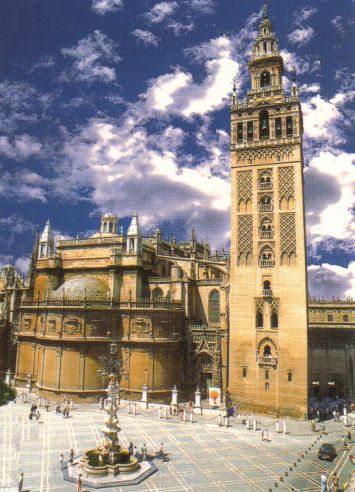
   La Giralda. the steles are to be found at
   the right-hand corner of the base.
   (photo courtesy of losmejoresdestinos.com)
Humankind has been recycling ever since the first humanoid picked up a bone from his last meal and bashed someone over the head with it - from bone to bone-crusher in one fell swoop of all too-human intuition. 

Staying in Seville, most of the older brick buildings in the city were made with Roman bricks quarried from the nearby Roman ruins of Italica. Indeed, the cathedral's Moorish belltower, La Giralda, was built using such bricks and at ground level we can even see some marble Roman steles. We can therefore surmise that in those times input costs in descending order would have been: materials/ transport/labour.

Nowadays, and in general terms,  that order has changed and has become labour/transport/ materials in the developed world and transport/labour/materials in the developing world, although the latter two might very well be interchangeable. 

Yet it is only right that labour should be paid a fair and living wage. We are talking about people, about families. About society.

But I digress. Last week (the trigger for this article) I saw a scrap metal scavenger pulling yards and yards of copper wiring from a skip -obviously for re-sale (at a pittance) to scrap metal dealers. Everyone knows that scrap is bought by weight and that therefore the plastic will be heavily discounted from the price paid. So how to maximise the  price? By stripping the wire of its plastic (usually PVC, if it's old wiring - which logically it will be). Anyone who has stripped even a small length of wire knows how arduous and time-consuming such a task is, so I am sure that you too, dear reader, have already hit upon the most efficient solution - burn the plastic off. This obviously releases noxious, highly poisonous gases, harmful to both the environment and to the incendiaries themselves. Furthermore, such  activities will also blight the ground beneath the fire and in summer months might even lead to larger, uncontrollable, bush fires.    

Another, similar, case is the scavenging of old fridges. No economically "sensible", scrap merchants will accept a fridge full of CFCs which they will then have to re-process according to  legal requirements. Again, the solution is obvious: smash open the cooling system in the street so that when it arrives at the scrapyard, it is CFC-free. 

Thankfully, and probably due to the fact that the cost of recycling is included in the price of new tyres,  tyre-burning to recover the steel inside is now uncommon. Furthermore, the plumes of dense, black smoke can be seen from a long way off and will thus alert the authorities. Until about ten years ago tyres were the fuel of choice in the brick fields beside the Guadalquivir when starting up the brick kilns. These bricks, incidentally, still used the same - or same-size moulds as those used in Roman times. 

The riverine brick kilns are now a thing of the past, but: how can we make such uncontrolled recycling a thing of the past too? That is a knottier problem, but one which requires society to recycle the people it throws onto the scrap heap instead of obliging them to lose their dignity and become members of an underclass that the rest of us hardly see as we go about our daily lives, blithely oblivious to the fact that it only takes a small chain of personal economic disasters to find ourselves in the same degrading position.